
Before we talk about what it takes to get AI adoption right, think back to the last time your organization rolled out a new tool, process, or operating model.
On paper, it probably checked all the boxes: faster approvals, cleaner tracking, better visibility, and more automation. But the rollout may not have felt as smooth as leadership expected.
- Employees were unclear about why the change was happening.
- Teams continued relying on old processes or workarounds.
- Training was too generic or disconnected from how people actually work.
- Managers communicated the change once but did not consistently reinforce new behaviors.
So yes, the tool or process may have technically gone live. But adoption lagged. Frustration increased. And the expected efficiency gains never fully materialized.
That story is familiar to most organizations. In the AI era, it matters even more.
AI adoption is not just another technology rollout. It changes not only the tools people use, but also the judgment, trust, accountability, and decision-making patterns behind the work. It requires deeper changes in how people make decisions, complete work, trust outputs, manage risk, and collaborate with intelligent systems. And because AI investments often come with high expectations for speed, productivity, and measurable business value, the cost of slow or shallow adoption is high.
At Nextant, we see this pattern play out every day. The organizations making the most progress with AI are simply not investing more in technology. They are creating the conditions for adoption, behavior change, and value realization from the start.
Below are four success factors we consistently see in organizations making the most meaningful progress with AI.
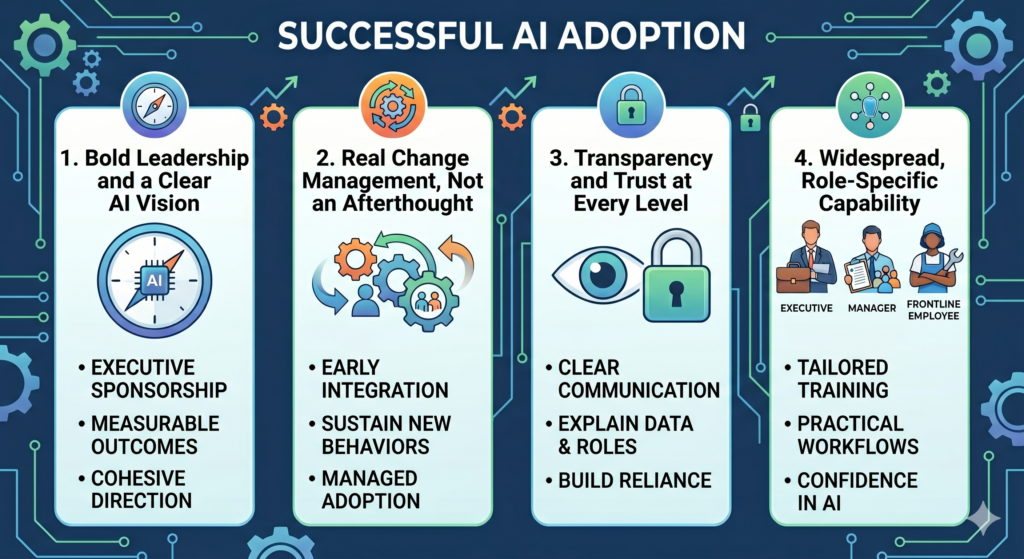
1. Bold Leadership and a Clear AI Vision
Organizations that take an overly cautious or fragmented approach to AI often struggle to build momentum. The ones pulling ahead combine strong executive sponsorship with clear strategic direction.
When leadership is unclear, adoption is unclear. Employees may see AI as another experiment, a productivity tool for individual use, or a threat to their roles rather than a strategic shift in how the organization creates value. That is why a bold, well-defined AI vision matters. It sets the direction, clarifies what success looks like, and connects AI adoption to measurable business outcomes from the start.
A clear and compelling vision turns AI from a series of disconnected pilots into a coordinated business transformation. It creates alignment, builds trust, and gives employees a reason to engage with the change, not just comply with it.
At Nextant, we help organizations define and activate this vision through our AI Strategy offerings. This work starts by aligning leadership around business priorities, AI maturity, use-case opportunities, risks, and the operating model required to scale responsibly. But defining the strategy is only the beginning. The vision must also be communicated in a way that resonates with different stakeholder groups across the organization.
To support this, we use proven change management tools such as Prosci’s Project Change Triangle (PCT), which reinforces the connection between leadership and sponsorship, project direction, and change management. This helps ensure the AI vision is not just aspirational, but supported by the structure required to make it real: active sponsorship, clear execution, and intentional adoption planning. The goal is to help every stakeholder understand why the change matters, what it means for them, and how their adoption contributes to business value.
2. Real Change Management, Not an Afterthought
AI adoption does not happen simply because a tool is deployed, a training session is delivered, or communication is sent. It happens when people understand the change, believe it matters, know how to apply it, and are supported long enough for new behaviors to stick.
That is why change management cannot be improvised or added late in the process. For meaningful AI initiatives, it must be built into the transformation from the start. Change management ensures the right stakeholders receive the right information, at the right time, through the right channels, with the right level of support.
This is especially important with AI because adoption requires more than learning a new interface. Employees are being asked to change how they work, make decisions, assess quality, and trust technology-supported outputs. Without intentional change management, even well-designed AI solutions can become underused, misunderstood, or resisted.
To make this practical, we use proven methodologies, such as Prosci’s (ADKAR®) framework, to structure adoption programs around five critical outcomes: Awareness, Desire, Knowledge, Ability, and Reinforcement. This helps us identify where each stakeholder group may need support, from understanding why the change is happening to building the skills and confidence required to use AI effectively.
Gaps in any part of the adoption journey can reduce the value of an AI investment. A team may understand the business case but lack the ability to apply the solution. Employees may complete training but hesitate because they do not trust the outputs or understand the guardrails. Managers may endorse the change but fail to reinforce new behaviors after launch.
When these gaps are not addressed, adoption slows, frustration builds, and ROI is delayed. Over time, this can also create skepticism toward future AI efforts, making each subsequent initiative harder to launch and scale.
Real change management helps prevent that pattern. It turns AI adoption from a one-time rollout into a structured, measurable path toward behavior change, sustained usage, and business value.
3. Transparency and Trust at Every Level
AI adoption depends on trust. Employees are being asked to rely on intelligent systems in ways that feel new, unfamiliar, and sometimes uncomfortable. They may use AI to accelerate analysis, draft communications, summarize information, support decisions, or automate parts of work that previously required human judgment.
That makes transparency essential. If employees do not understand why AI is being introduced, how it works, what data it uses, where the guardrails are, and how it will affect their roles, adoption will suffer.
In AI change programs, the Awareness and Desire stages of Prosci’s (ADKAR®)framework are important, as these are the phases where people begin forming their perception of the change. Do they understand why the organization is investing in AI? Do they believe it is relevant to their work? Do they feel safe, supported, and equipped to participate?
Transparency must be embedded into communications, workshops, training, leadership messaging, and manager enablement. That means clearly explaining the purpose of the AI initiative, the business value it is intended to deliver, the ethical and security considerations it addresses, and the role employees play in using AI responsibly.
Trust also needs to be built at every level of the organization. Executives may see AI through the lens of strategy, productivity, and competitive advantage, while employees closer to the work may focus on practical concerns: Will this change my role? Can I trust the outputs? What happens if the AI is wrong? Is my data secure? Am I being evaluated based on how I use it?
Closing that trust gap requires visible sponsorship, consistent messaging, open feedback loops, and tailored engagement for different stakeholder groups. Leaders must reinforce the “why,” managers must create space for questions and experimentation, and project teams must show how concerns are being heard and addressed.
When transparency is handled well, trust becomes an accelerator for adoption. Employees are more willing to experiment, apply AI to real work, raise risks early, and help shape better solutions.
4. Widespread, Role-Specific Capability
AI is not just a tool rollout. It is a shift in how work gets done, and different roles experience that shift in different ways.
Executives may focus on strategy, productivity, risk, and competitive advantage. Managers may need to understand how AI changes team workflows, performance expectations, and coaching. Frontline employees may be looking for practical ways to reduce manual effort, improve quality, or make day-to-day tasks faster and easier.
That is why a one-size-fits-all enablement approach does not work.
Effective AI adoption requires role-specific communication, training, and use cases that connect directly to how people work. Employees need to see practical examples that feel relevant to their responsibilities, not generic demonstrations that leave them wondering how AI applies to their job.
For example:
- Sales leaders can use AI to prepare for client conversations, identify pipeline risks, and summarize account insights.
- Marketing teams can use AI to accelerate content creation, campaign planning, audience research, and performance optimization.
- Consultants can use AI to streamline research, synthesize information, build deliverables, and improve reporting quality.
- Managers can use AI to summarize team updates, identify blockers, prepare communications, and support better decision-making.
These role-specific applications are what make AI feel practical, useful, and worth adopting. They help employees move from general curiosity to confident usage.
Our enablement approach connects AI capabilities to real workflows through stakeholder-specific messaging, practical training, hands-on workshops, curated use-case libraries, and reinforcement activities that help teams build confidence over time. The goal is not just to teach people what AI can do, but to help them understand how to use it responsibly and effectively in the moments that matter most to their work.
When capability-building is role-specific, AI becomes less abstract. Employees can see where it fits, how it helps, and how to adopt it to create measurable value.
The Nextant Take
These four conditions are the foundation of how we help organizations drive AI adoption at Nextant. We translate strategy, sponsorship, trust, and capability-building into practical change journeys that move teams from experimentation to measurable impact.
The organizations that succeed with AI will not be the ones that simply deploy more tools. They will be the ones that help their people understand, trust, and apply AI in ways that improve how work gets done.
That is where real AI value begins.
Want to assess where your organization stands across these four conditions? Connect with Nextant for a conversation.