Enterprise R&R and Organizational Navigation Platform Overview
The client, a large enterprise organization, sought to improve cross-organizational visibility, accountability, and collaboration by creating a centralized Roles and Responsibilities solution that increased visibility for employees and leadership teams. As the organization continued to expand and evolve through restructuring, shifting priorities, and growing operational complexity, employees faced increasing challenges in identifying role ownership, team structures, subject matter experts, and internal navigation paths across the organization.
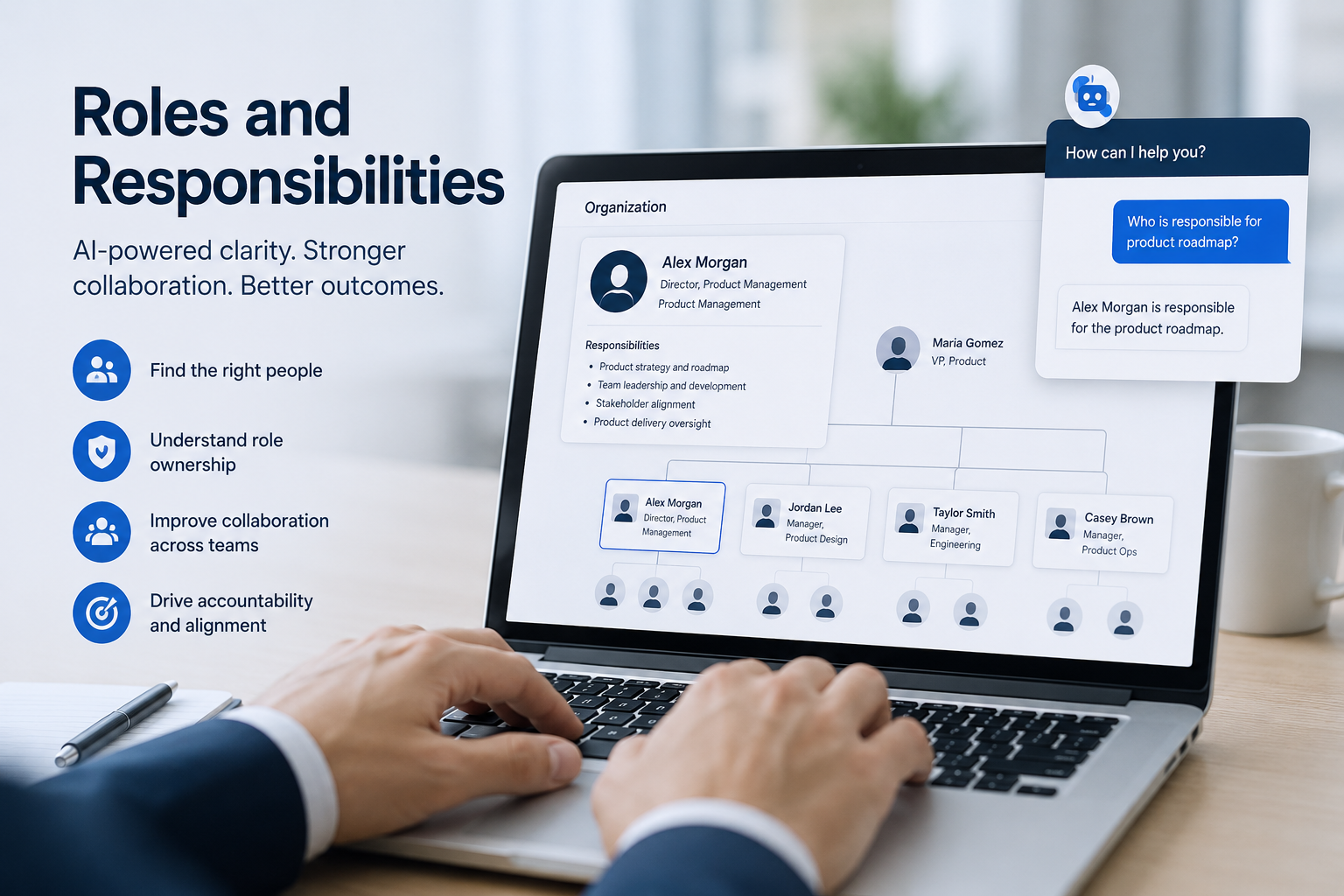
To address these challenges, the client partnered with Nextant to design and implement an App & Agent Solution that would provide employees with real-time visibility into organizational roles, responsibilities, reporting structures, and areas of expertise. The initiative included developing a centralized PowerApps-based platform integrated with organizational data sources and enhanced with an AI-powered conversational agent that helps users quickly locate information, identify key stakeholders, and navigate the organization more efficiently.
The engagement encompassed discovery and scoping, data architecture design, application and AI agent experience design, conversational framework development, and ongoing support and maintenance.
Enterprise Challenges with Organizational Visibility and Increased R&R Visibility
As the organization scaled, maintaining visibility into team structures, role ownership, and business responsibilities became increasingly difficult. Employees often struggled to identify the correct points of contact for projects, decisions, approvals, or subject matter expertise related to Roles and Responsibilities across the organization. Organizational changes, evolving priorities, and restructuring efforts further complicated internal navigation and collaboration.
Clear Roles and Responsibilities frameworks are critical for improving accountability, communication, and organizational alignment across enterprise teams, as highlighted by the Society for Human Resource Management (SHRM).
One of the client’s primary challenges was the lack of a centralized, continuously updated repository that clearly defined team members’ responsibilities, project ownership, and organizational relationships. Information on roles and responsibilities was fragmented across multiple systems, documents, and teams, leading to inconsistencies, duplication of effort, and communication delays.
The organization also faced challenges in maintaining strong team morale during periods of growth and operational transformation. Without a standardized mechanism for documenting and updating role ownership, employees frequently relied on informal channels to locate information or identify collaborators, reducing efficiency and increasing dependency on institutional knowledge.
Additionally, leadership teams required a scalable solution that could support:
- Collaboration: Enable cross-functional collaboration across large, distributed teams
- Expertise discovery: Make it easier to identify subject matter experts
- Ownership clarity: Improve accountability and transparency around roles and responsibilities
- Organizational navigation: Help employees navigate the organization more easily
- Career visibility: Support career exploration and visibility into organizational structures
- Efficiency: Reduce the time spent searching for information and contacts
The client needed a modern, user-friendly solution that integrates with HR systems and existing organizational data while providing intuitive access to information through both traditional navigation and conversational AI experiences.
AI-Powered R&R Solution Built with Microsoft Power Platform
To address the organization’s challenges around role visibility, accountability, and organizational navigation, Nextant designed and implemented a comprehensive App & Agent Solution built on Microsoft Power Platform technologies and AI-driven conversational capabilities.
The solution focused on developing a centralized Platform using PowerApps, enabling the organization to consolidate role ownership, team structures, responsibilities, and areas of expertise into a single, accessible source of truth.
Nextant’s approach included multiple phases covering discovery, architecture design, application development, AI integration, and ongoing support.
Discovery & Scoping
Nextant began the engagement by conducting discovery sessions with stakeholders to better understand the organization’s structure, business processes, collaboration challenges, and Roles and Responsibilities requirements to support the desired user experience.
This phase included:
- Understanding organizational structures and reporting relationships
- Defining required fields for team charters and role documentation
- Identifying expected navigation flows and functionality requirements
- Mapping user journeys and key use cases
- Identifying prompts and conversational patterns that users would leverage within the AI agent experience
This discovery process ensured that the final solution aligned closely with both operational requirements and employee needs.
Data Architecture & Integration
A key component of the solution involved designing a scalable, sustainable data architecture that integrates information from HR systems and organizational data sources.
Nextant identified and mapped the required data sources and established the architecture for data input, transformation, and output to support accurate visibility into Roles and Responsibilities across the organization. Automated integrations were implemented to continuously refresh organizational information and ensure that team structures, reporting lines, and role ownership remained up to date.
The architecture was designed to support:
- Scalability across large organizational structures
- Automated synchronization with HR data
- Secure and role-based access management
- Centralized visibility into organizational information
- Future extensibility for additional functionality and integrations
This centralized data framework became the foundation for both the application experience and the AI-powered agent capabilities.
App & Agent UX Design and Development
Nextant designed and developed a user-friendly Roles and Responsibilities application experience that simplifies organizational navigation and improves access to role-related information.
The App included features such as:
- Team and role navigation capabilities
- Organizational chart functionality
- Visibility into role ownership and responsibilities
- Searchable directories of employees and subject matter experts
- Accessibility and permissions management
- Dynamic team charter visibility
In parallel, Nextant developed an AI-powered conversational agent that provides instant, self-service access to Roles and Responsibilities and organizational information.
The conversational AI experience enabled users to:
- Identify role ownership for projects and business functions
- Locate subject matter experts across the organization
- Navigate team structures and reporting relationships
- Access team context and responsibilities
- Ask natural language questions related to organizational information
The AI agent supported both structured menu-driven interactions and free-flow conversational experiences, providing employees with a flexible and intuitive way to access information.
Nextant also designed the logic framework, prompt structure, and parameter definitions that powered the agent’s functionality and ensured accurate responses.
Sample Deliverables
The engagement included the delivery of:
- Navigator application interfaces
- Organizational chart functionality
- Conversational AI agent interface
- Centralized role and team visibility tools
- Data architecture and integration framework
- Ongoing maintenance and operational support
Maintenance & Continuous Support
To ensure long-term sustainability, Nextant provided ongoing maintenance and support services for the Roles and Responsibilities solution, including platform enhancements, issue resolution, and operational hand-off support when needed.
The team also collaborated closely with stakeholders to continuously refine the experience and ensure alignment with evolving organizational structures and business needs.
Business Results and Organizational Impact of the R&R Platform
The Roles and Responsibilities App & Agent Solution delivered significant operational and organizational benefits for the client by improving visibility, accountability, collaboration, and employee navigation across the enterprise.
- Stronger Accountability: Centralized visibility into role ownership and business responsibilities improved accountability across teams and functions. Employees gained a clearer understanding of ownership structures, reducing confusion around responsibilities and decision-making.
- Improved Cross-Functional Collaboration: The platform enabled employees to more easily identify the right individuals, teams, and subject-matter experts to support business initiatives and clarify Roles and Responsibilities across the organization. This improved collaboration across departments and reduced delays caused by a lack of organizational visibility.
- Enhanced Organizational Navigation: The centralized application and AI-powered agent significantly simplified navigating complex organizational structures. Employees were able to quickly locate team information, reporting relationships, and ownership details without relying on informal communication channels.
- Increased Efficiency Through Self-Service Access: The conversational AI experience provided instant, self-service access to Roles and Responsibilities and organizational information, reducing the time employees spent searching for contacts, responsibilities, and internal resources.
- Better R&R Clarity During Organizational Changes: The continuously refreshed integrations with HR systems kept role and team information up to date, even amid growth, restructuring, and shifting priorities. This helped maintain strong role clarity signals across the organization.
- Improved Employee Experience: The intuitive user experience and conversational navigation capabilities created a more accessible, user-friendly way for employees to engage with Roles and Responsibilities and organizational information, improving the overall employee experience and reducing friction in day-to-day collaboration.
- Career Exploration and Visibility: The solution also supported employee career exploration by providing greater visibility into business functions, team structures, and organizational roles, helping employees better understand potential career paths within the organization.
- Scalable Organizational Infrastructure: By implementing a centralized, scalable platform architecture, the organization established a long-term foundation for visibility into Roles and Responsibilities, collaboration, and operational alignment that can continue to evolve with the business.