
Overview
A professional services firm launched a three-month, company-wide initiative to establish artificial intelligence as a core behavior across its workforce. The organization included approximately 180 employees spanning technical consulting, non-technical professional services, and corporate support functions such as Finance and Accounting, Human Resources, Information Technology, Sales and Marketing, and Business Operations.
Before the initiative, employees were already experimenting organically with artificial intelligence. Some individuals had incorporated AI into their daily work, while others had limited experience, uncertainty about its relevance, or concerns about its implications. Adoption varied significantly across teams, roles, and levels of proficiency.
The organization recognized that providing access to AI tools would not, by itself, create sustained adoption or measurable business value. Employees needed to understand why AI mattered, how it applied to their roles, how to use it responsibly, and how to develop the skills and confidence required to make it part of their everyday work.
Nextant designed and led a structured AI adoption and change management program to move the organization from fragmented experimentation toward broad, responsible, and value-oriented usage. The program combined executive leadership, employee segmentation, targeted communications, practical enablement, use case development, peer advocacy, and measurement.
The initiative supported a broad AI technology strategy that included Gemini, Claude, Microsoft Copilot, custom AI solutions, and specialized development tools for technical teams. Rather than promoting one platform, the program focused on helping employees select and use the appropriate AI capabilities for their responsibilities and business needs.
Within three months, the organization achieved measurable improvements in employee sentiment, AI readiness, daily adoption, use case sophistication, and estimated time savings.
The Challenge
The organization had already developed pockets of organic AI usage. Several employees were actively experimenting with generative AI, using it to accelerate research, create content, analyze information, develop software, and support day-to-day decision-making.
However, organic adoption was not progressing consistently across the company.
Some employees were enthusiastic early adopters, while others were curious but unsure where to begin. Certain employees had concerns about accuracy, security, job impact, or the effort required to learn new tools. Employees also had different levels of technical proficiency and significantly different opportunities to apply AI depending on their roles.
As a result, AI adoption was uneven and largely dependent on individual initiative.
The organization faced several related challenges:
- Inconsistent adoption across roles and teams. Technical employees generally had more immediate exposure to AI tools, while employees in non-technical and support functions often needed more guidance to identify relevant applications.
- Limited visibility into valuable use cases. Employees were experimenting independently, but the organization did not have a centralized mechanism for capturing, validating, and sharing successful use cases.
- Uncertainty about responsible AI usage. Employees needed practical guidance on what information could be used with AI tools, when outputs required human validation, and which activities were appropriate for different technologies.
- Different levels of confidence and readiness. A single training program would not adequately address employees ranging from resistant or apprehensive users to advanced practitioners.
- Lack of a formal adoption pathway. The organization had access to multiple AI platforms but no coordinated program to help employees progress from initial awareness to regular, increasingly sophisticated usage.
- Limited evidence for investment decisions. Without consistent adoption data and a clear understanding of high-value use cases, it was difficult to determine which AI technologies, licenses, and custom solutions would generate the greatest return.
The organization needed to move beyond optional experimentation and establish AI as a practical, responsible, and measurable component of how work was performed.
Nextant’s Role
Nextant served as the change management and AI adoption partner for the initiative. Its role was to design and execute a company-wide program that addressed both the human and technical dimensions of adoption.
The core Nextant team included participation of:
- A change management program manager responsible for program design, stakeholder alignment, execution, and measurement
- An AI subject matter expert responsible for use case guidance, practical enablement, and technology alignment
- A communications specialist responsible for campaign development, messaging, employee engagement, and success-story amplification
- Close partnership with the organization’s executive leadership and Human Resources teams
Nextant worked with leadership to translate the organization’s strategic commitment to AI into a coordinated set of employee experiences. This included executive communications, company-wide events, team-level workshops, targeted interventions, practical resources, peer advocacy, and an agentic solution that provided personalized AI coaching.
The program was designed around a central principle: employees would adopt AI more consistently when they understood its relevance to their roles, saw trusted peers using it successfully, received appropriate support, and could experiment within clear responsible-use boundaries.
Nextant also established a measurement approach that combined employee survey responses and available usage telemetry. This allowed the organization to evaluate not only whether employees had access to AI, but also whether their attitudes, capabilities, behaviors, and use cases were changing.
Approach
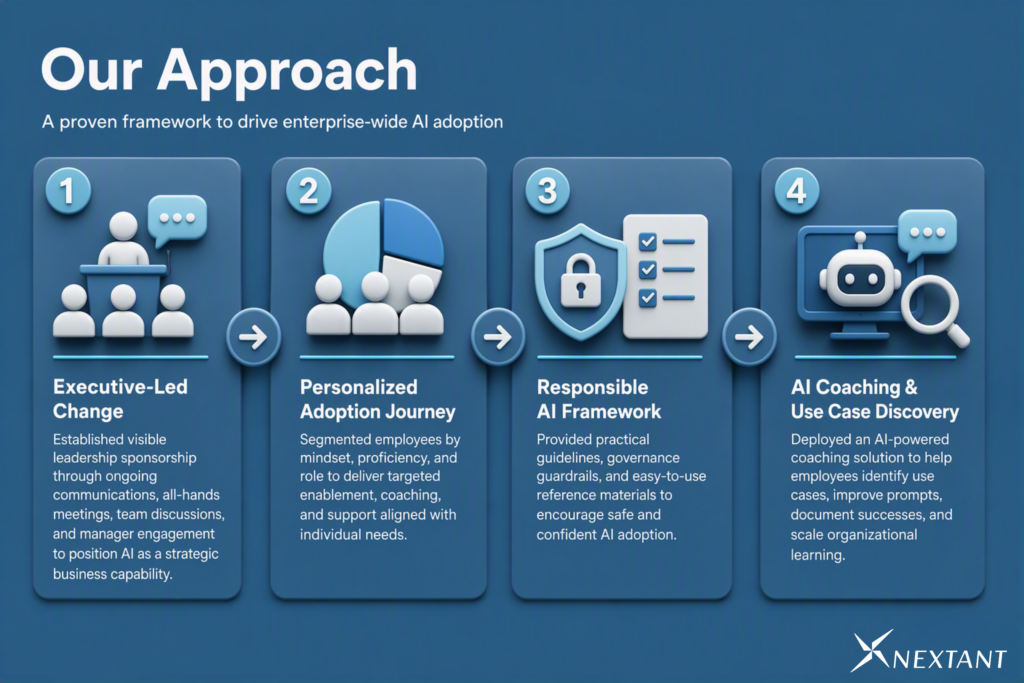
1. Establishing Visible and Consistent Executive Sponsorship
The initiative began with strong and sustained executive endorsement.
Leadership communicated that AI adoption was not a temporary technology campaign or an optional productivity exercise. It was an important organizational capability and an expected component of how employees would work, learn, and serve clients.
Nextant developed a communications and engagement campaign that reinforced this message through multiple channels, including:
- Executive emails
- Dedicated segments during company-wide all-hands meetings
- Leadership discussions during team meetings
- One-to-one conversations with individual employees
- One-to-many conversations with teams and employee groups
- Informal reinforcement through everyday leadership interactions
The campaign focused on building understanding and excitement rather than relying on mandates alone. Leaders shared why AI mattered to the company, how it could improve the employee experience, and how responsible adoption would strengthen the organization’s competitiveness.
Repeated executive participation helped employees see that the initiative had genuine leadership commitment and was connected to the company’s long-term direction.
2. Segmenting Employees to Provide the Right Adoption Experience
Nextant avoided treating the workforce as a single, uniform audience.
Employees were segmented using three principal dimensions:
- Attitude toward AI. Employees were assessed based on whether they were enthusiastic, positive, uncertain, skeptical, resistant, or concerned about AI adoption.
- Level of proficiency. Employees ranged from individuals with little or no practical experience to advanced users already applying AI across multiple activities.
- Type of usage appropriate for the employee’s role. The program differentiated among general productivity use cases, functional or role-specific applications, technical development use cases, and opportunities involving custom AI solutions.
This segmentation allowed Nextant to tailor communications, learning experiences, and interventions.
Employees who were interested but inexperienced received practical examples and accessible starting points. More advanced users received opportunities to deepen their usage and support others. Employees expressing concern or resistance participated in smaller conversations where their questions could be addressed directly.
The segmentation also helped the organization avoid unnecessary technology investments. Access, coaching, and enablement could be aligned with employee readiness and the relevance of specific tools to each role.
3. Creating Clear Guardrails for Responsible AI Usage
Responsible usage was incorporated throughout the program rather than treated as a separate compliance activity.
During company-wide meetings, Nextant and organizational leaders presented practical guidance on the appropriate and inappropriate use of AI. Topics included protecting sensitive information, validating AI-generated outputs, maintaining human accountability, understanding potential inaccuracies, and choosing approved tools for different activities.
Concise one-page reference materials were also developed so employees could quickly consult the organization’s AI usage expectations while working.
The guidance was designed to enable experimentation while reducing risk. Employees were encouraged to use AI, but they were also given clear boundaries and an understanding of when human review, expert judgment, or additional verification was required.
By pairing encouragement with responsible-use guidance, the organization reduced uncertainty and made employees more comfortable incorporating AI into their daily work.
4. Launching an Agentic AI Coach and Use Case Discovery Solution
A central component of the program was the launch of an agentic solution that helped employees translate general interest in AI into practical applications.
Employees could interact with the solution to:
- Describe their role, responsibilities, or recurring work activities
- Identify potential AI use cases
- Refine an initial idea into a more specific application
- Receive coaching on prompt construction
- Improve prompts based on the intended outcome
- Consider responsible-use requirements
- Document successful or promising use cases
The solution provided immediate, personalized assistance while also creating a scalable mechanism for organizational learning.
With each interaction, the company gained greater visibility into how employees wanted to use AI. These insights contributed to a growing use case library that employees could consult for inspiration and practical examples.
The use case data also provided leadership with evidence to evaluate future technology investments. By identifying recurring needs, frequently requested capabilities, and the most productive applications, the organization could make more informed decisions about licenses, platforms, custom solutions, and training priorities.
The agentic solution therefore served two purposes: it coached employees at the moment of need and created an enterprise-level feedback loop for AI strategy and investment.
5. Delivering Company-Wide and Team-Specific Workshops
Nextant facilitated workshops at both the company and team levels.
Company-wide sessions introduced common concepts, demonstrated accessible use cases, reinforced responsible usage, and highlighted successes from across the organization.
Team-specific workshops focused more directly on the activities performed by particular groups. Examples were tailored to the needs of technical consultants, non-technical professional services teams, and functions such as Finance, HR, IT, Sales and Marketing, and Business Operations.
Rather than focusing primarily on tool features, workshops demonstrated how employees could improve actual work activities. Sessions emphasized practical applications such as summarizing information, preparing deliverables, developing content, analyzing data, supporting decision-making, creating code, researching topics, and improving internal processes.
Employees also heard success stories from colleagues who had already benefited from AI. These stories helped make adoption tangible and demonstrated that AI was relevant to a wide range of roles—not only to developers or highly technical employees.
6. Addressing Resistance Through Small-Group Conversations
The program acknowledged that resistance to AI could not be resolved entirely through broad communications or demonstrations.
Nextant conducted small-group conversations with employees who expressed hesitation, concern, or aversion toward AI adoption. These discussions provided a more comfortable setting for employees to explain their perspectives and ask questions.
Common concerns included the reliability of AI outputs, uncertainty about how AI applied to a particular role, fear of making mistakes, discomfort with changing established working methods, and concern about the long-term impact of AI on jobs.
The conversations did not dismiss these concerns. Instead, facilitators provided context, demonstrated practical examples, clarified expectations, and emphasized the continuing importance of human judgment and expertise.
This targeted approach helped the organization distinguish between employees who needed additional skills, employees who needed reassurance, and employees who needed clearer evidence that AI could improve their work.
7. Activating Power Users and Champions
Employees were often more influenced by the experiences of trusted colleagues than by formal corporate messages.
Nextant identified and encouraged power users and informal AI champions to share how they were using AI, what they had learned, and what benefits they had experienced.
Champions shared their stories through formal channels, including team meetings, workshops, and company events. They were also encouraged to discuss AI organically through peer-to-peer interactions, hallway conversations, informal coaching, and day-to-day collaboration.
This created a distributed network of adoption support. Employees could observe people in similar roles using AI successfully and could seek guidance from colleagues who understood their work.
Champions were not positioned only as technology experts. Their most important role was to make AI usage practical, credible, and approachable for others.
8. Measuring Changes in Attitude, Capability, Behavior, and Value
Nextant established a measurement framework to monitor progress throughout the three-month initiative.
The program evaluated multiple dimensions of adoption:
- Employee sentiment toward AI
- Self-reported AI readiness and proficiency
- Frequency of AI usage
- Sophistication of use cases
- Estimated time savings
- Available platform and usage telemetry
This multidimensional approach was important because tool activation alone would not indicate successful adoption. An employee could have access to AI without using it regularly, or could use it frequently without applying it to meaningful work.
By combining survey responses with telemetry data, the organization developed a more complete view of behavioral change and emerging business value.
Results
After three months, the organization demonstrated significant progress across employee sentiment, readiness, behavior, use case maturity, and productivity.
- 95.6% of employees reported a very positive attitude toward using AI: The initiative established broad organizational support for AI adoption. Nearly the entire workforce reported a highly positive attitude, indicating that the communications, leadership engagement, targeted conversations, and practical experiences had successfully addressed many of the initial uncertainties surrounding AI.
- Advanced or expert AI readiness increased by 15 percentage points, reaching 65%: Nearly two-thirds of employees assessed themselves as having advanced or expert AI readiness by the end of the program. This demonstrated that the initiative did more than generate awareness—it increased employees’ confidence and perceived ability to apply AI effectively.
- Daily AI usage increased from 54% to 70% of employees: The share of employees using AI every day increased by 16 percentage points. This represented an approximately 30% relative increase in daily users and demonstrated that AI was becoming part of employees’ regular working behavior rather than remaining an occasional experiment.
- Intermediate and expert-level AI use cases increased by 4.4% and 33%, respectively: Employees did not simply use AI more frequently; they also began applying it to more sophisticated activities. The 33% increase in expert-level use cases was particularly significant because it indicated movement toward higher-value applications involving more complex reasoning, workflows, technical activities, and business processes.
- The organization identified approximately 520 hours of productive capacity each week: Survey responses and available usage telemetry indicated that AI-supported activities were saving approximately 520 employee hours per week across a workforce of 115 people.
This represented an average of approximately 4.5 hours per employee each week and the equivalent of roughly 13 full-time employees’ weekly capacity. If sustained over a full year, the productivity impact would represent more than 27,000 hours of potential capacity.
The result did not imply an immediate reduction in headcount. Instead, it demonstrated the organization’s ability to redirect significant employee capacity toward higher-value activities, increased delivery volume, faster turnaround times, improved quality, client service, innovation, and growth.
For business leaders, this finding provided an important basis for future decisions. The organization could begin evaluating AI investments based not only on employee interest or tool usage, but also on the productive capacity generated and the business outcomes to which that capacity could be redirected.
Conclusion
In three months, the organization moved from fragmented, employee-led experimentation to a coordinated enterprise AI adoption model.
The initiative demonstrated that successful AI adoption requires more than technology access or isolated training. It requires visible executive leadership, differentiated employee journeys, responsible-use guidance, role-relevant use cases, practical coaching, peer advocacy, targeted resistance management, and disciplined measurement.
By combining these elements, Nextant helped the organization establish a strong foundation for sustained AI adoption. Employees became more positive, capable, and consistent in their usage. Use cases became more sophisticated, and the company gained greater visibility into the productivity impact and technology investments associated with AI.
Most importantly, AI began to evolve from a collection of individual tools into a core organizational behavior and a measurable source of business capacity.