
Helping a major telecom provider move from fragmented legacy systems to a unified billing and customer support platform without disrupting operations.
Overview: From System Migration to Workforce Adoption
A major telecom company undergoing acquisition faced a high-stakes transformation: replacing multiple legacy billing and customer support systems with a single unified platform across five sequential rollout phases. The technical migration was only part of the challenge. To realize the full value of the new platform, the organization needed employees to understand the change, build confidence in the new ways of working, and be ready to operate effectively from day one of each go-live.
Nextant was engaged to design and lead an end-to-end change management program that would reduce disruption, build readiness phase by phase, and help the workforce adopt and sustain the new system with confidence. Over a 17-month engagement, Nextant coordinated sensitization, communications, training, governance, and measurement into a single integrated adoption strategy.
Challenge: Building Confidence in a Complex, High-Pressure Transformation
The transformation began in an environment of low awareness and high uncertainty. Many employees had learned about the initiative through informal channels rather than official communications, creating space for confusion, speculation, and resistance. At the same time, employees were concerned about potential role changes, workforce reductions, and whether they would have enough time and support to learn the new platform before go-live.
The organization also had to manage competing priorities. Parallel initiatives were already demanding attention from employees and leaders, increasing the risk of change fatigue. With five stakeholder groups across sponsors, call center teams, general employees, the project team, and external parties, each audience required a tailored approach to messaging, engagement, and support.
The stakes were especially high because the rollout followed firm milestones with financial penalties attached. Readiness could not be treated as a one-time activity or a final training push. It had to be built consistently across every phase, with clear governance, practical enablement, and continuous feedback to ensure each group was prepared before the next transition.
Approach: A Practical Change Program Designed Around Adoption
Nextant leveraged the ADKAR® methodology to structure the program around a five-step process that moved from kick-off and readiness through analysis, planning, diagnosis, design, implementation, and adoption.
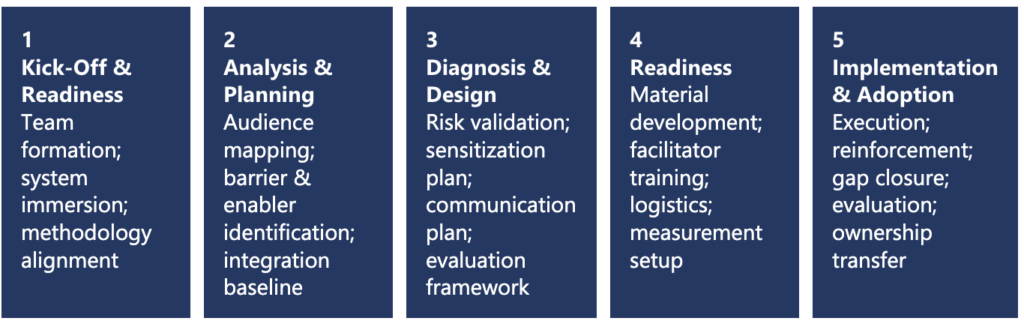
This provided a disciplined framework for managing the transformation while allowing the team to adapt activities to the needs of each rollout phase.
The work started with a detailed change diagnosis using surveys, interviews, and focus groups to assess readiness across prior change experience, sponsorship quality, skills gaps, resistance factors, and communication effectiveness. These insights shaped a strategy that was not generic, but audience-specific: sponsors received focused alignment sessions, employees received clear before-and-after messaging, and frontline teams were supported with FAQs, cascade briefings, virtual suggestion channels, and regional Q&A sessions.
Throughout the engagement, Nextant anchored the program in four guiding principles:
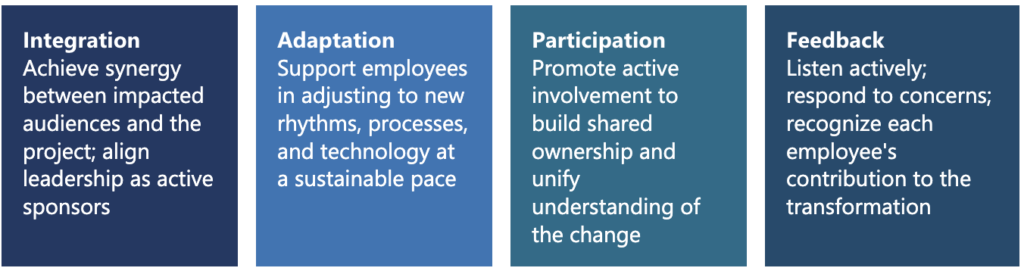
Change activities were integrated with the broader implementation plan, adapted to each audience, designed to encourage participation, and continuously refined through measurement and employee input.
To make readiness sustainable, Nextant also implemented a Train the Trainer model that certified approximately 80 internal trainers. The team developed 25 simulation cases, role-specific manuals, and computer-based training assets so employees could practice real scenarios before go-live, reducing uncertainty and improving adoption once the system was live.
Results: A Confident Workforce and a Disruption-Free Migration
The program enabled all five rollout phases to be delivered on schedule, with 100% of the customer base migrated without operational disruption. By treating workforce readiness as a core part of the transformation rather than an afterthought, the organization was able to move through each go-live with greater confidence and control.
After launch, the client saw a significant reduction in incident resolution time, supported by the practical training model, simulation-based preparation, and clear role-specific guidance delivered before each phase. The trainer network also created internal capability that extended beyond the project, enabling continued onboarding and reinforcement after Nextant’s engagement concluded.
Measurement remained central throughout the effort. Across six measurement rounds, the team tracked communication quality, awareness, leader recognition, and adoption progress against the 80%+ readiness target. This closed-loop approach helped identify issues early, adjust messaging and enablement, and strengthen readiness across successive phases.
Most importantly, the engagement helped shift how the organization viewed change management. In prior programs, the human dimension of technology delivery had often been underweighted. This transformation repositioned change management as a critical driver of implementation success, helping the client move from system deployment to sustainable workforce adoption.