Table of Contents
Overview
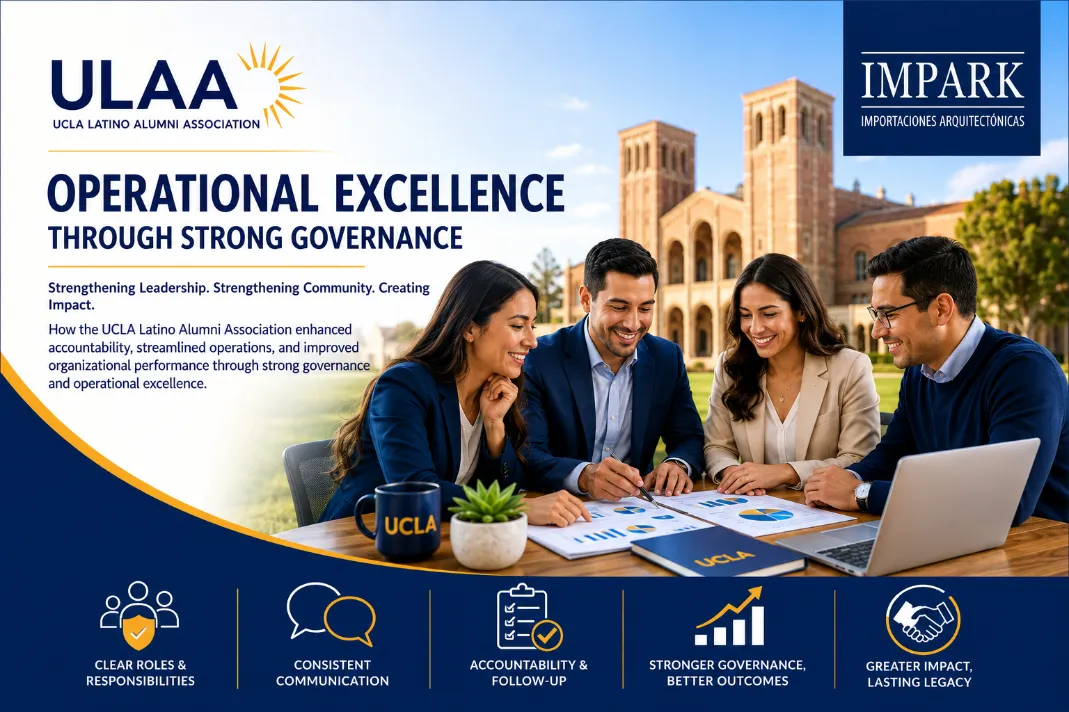
Operational excellence and strong governance are essential for organizations seeking long-term sustainability, accountability, and effective community engagement. The UCLA Latino Alumni Association (ULAA) is a cornerstone organization within the broader UCLA Alumni Association, dedicated to empowering and advancing the Latino community at the University of California, Los Angeles. Since its founding in 1989, ULAA has played a critical role in fostering connection, mentorship, and opportunity for Latino alumni, students, faculty, and staff while continuing to strengthen its governance and operational excellence initiatives to support long-term organizational growth.
Over the decades, the organization has built a strong legacy of impact. ULAA has awarded more than $1.5 million in scholarships to over 800 students, helping to reduce financial barriers and expand access to higher education. Beyond financial support, ULAA has also invested in leadership development through initiatives such as the OrgullOSO Mentorship Program, which connects students with alumni mentors to support their academic, professional, and personal growth. In a single year, the program facilitated approximately 286 mentor–mentee pairs, engaging over 570 participants.
Despite its success, ULAA operates as a volunteer-led organization. While this model enables passion-driven leadership and community engagement, it also introduces operational challenges related to consistency, accountability, scalability, and operational excellence. Recognizing these constraints, a structured effort was undertaken to strengthen ULAA’s governance, improve operational continuity, and enhance overall organizational effectiveness.
This article explores the challenges ULAA faced, the solutions implemented to address them, and the resulting impact on the organization’s ability to deliver on its mission.
Organizational Challenges
1. Inconsistent Availability and Operational Continuity
As a volunteer-led board, ULAA’s operations were inherently dependent on the availability and responsiveness of its members. Board members often balanced their responsibilities with demanding professional and personal commitments, leading to fluctuations in engagement, delays in decision-making, and challenges in maintaining consistent operational excellence.
This inconsistency posed risks to critical workstreams, including event planning, fundraising initiatives, and program execution. Without a stable operational backbone, the organization struggled to maintain continuity and deliver initiatives on time.
2. Limited Accountability Across Committees
ULAA’s Executive Committee oversaw multiple committees, each tasked with advancing specific organizational priorities. However, there was no standardized framework for tracking engagement, maintaining operational excellence, or ensuring accountability.
Committee leads did not consistently follow up with members, and there was limited visibility into progress, deliverables, or challenges. As a result:
- Tasks were not always completed on time
- Responsibilities were unclear or duplicated
- Opportunities for collaboration were missed
This lack of structure hindered the organization’s ability to operate efficiently and scale its impact.
3. Absence of a Centralized Volunteer Management System
Volunteers are the lifeblood of ULAA, yet the organization lacked a centralized system to manage them effectively. There was no unified way to:
- Track volunteer participation
- Understand availability and skill sets
- Assign volunteers to relevant initiatives
This led to inefficiencies in mobilizing support, especially for time-sensitive needs such as events or fundraising campaigns. Additionally, without proper tracking, it was difficult to recognize contributions, maintain long-term engagement, or sustain consistent operational excellence across committees and volunteer initiatives.
4. Underutilization of Volunteers
Even when volunteers were identified and available, they were not consistently integrated into committee activities. Board members did not always assign tasks to volunteers from the Volunteer Management Team, leaving untapped capacity and limiting opportunities to improve operational excellence across organizational initiatives.
This disconnect created frustration among volunteers and limited the organization’s ability to expand its reach and effectiveness.
5. Lack of Documentation and Knowledge Retention
ULAA faced a significant challenge in preserving institutional knowledge. Committee activities, decisions, and outcomes were not consistently documented, creating barriers to continuity, accountability, and long-term operational excellence, ultimately leading to:
- Loss of valuable insights and learnings
- Repetition of past mistakes
- Inefficient onboarding of new board members
Leadership transitions were particularly affected, as incoming members often lacked the context needed to continue initiatives seamlessly.

Strategic Solutions
To address these challenges, a comprehensive approach was implemented to strengthen governance, improve operational processes, and enhance operational excellence and engagement across the organization.
1. Strengthening Operational Support
To ensure continuity across key workstreams, dedicated support was provided to the Board President. This included:
- Assisting with event planning and execution
- Supporting corporate fundraising initiatives
- Managing logistics for board transitions
- Coordinating cross-functional activities
By centralizing operational support, ULAA was able to reduce reliance on individual availability and create a more stable foundation for its activities.
2. Defining Roles and Responsibilities
A critical step in improving accountability and operational excellence was the development and implementation of clear roles and responsibilities across the organization. Organizations seeking to strengthen governance and operational excellence often rely on industry best practices and nonprofit leadership resources provided by organizations such as BoardSource.
This included:
- Creating detailed documentation outlining expectations for each role
- Establishing agreements or contracts to formalize commitments
- Socializing these frameworks across the board and committees
These measures helped clarify ownership, reduce ambiguity, and ensure that all members understood their responsibilities.
3. Enhancing Communication and Follow-Up
Consistent communication was introduced as a key driver of engagement, accountability, and operational excellence. Structured follow-up processes were implemented to:
- Track progress on tasks and initiatives
- Reinforce commitments
- Address challenges proactively
Regular check-ins and updates improved alignment across committees and ensured that priorities remained on track.
Results and Impact
The implementation of these solutions led to significant improvements in ULAA’s governance and operations.
1. Increased Accountability and Ownership
With clearly defined roles and structured follow-up processes, board members and committee leads became more accountable for their responsibilities. This contributed to stronger governance and operational excellence across the organization, resulting in:
- Improved task completion rates
- Greater clarity in decision-making
- Enhanced collaboration across teams
2. Enhanced Volunteer Engagement
The introduction of a dedicated volunteer management system transformed how ULAA engaged with its volunteer base. The organization gained:
- Better visibility into volunteer capacity
- More efficient allocation of resources
- Higher levels of participation and satisfaction
Volunteers were no longer underutilized but became active contributors to the organization’s success.
3. Improved Operational Efficiency
Centralized support and structured workflows streamlined operations across the board. ULAA was able to:
- Execute events and initiatives more effectively
- Respond to time-sensitive needs with greater agility
- Reduce reliance on individual availability
Looking to strengthen governance, improve operational excellence, and create more effective organizational processes? Connect with Nextant to explore strategies that help organizations enhance accountability, operational continuity, and long-term organizational performance.
Conclusion
The UCLA Latino Alumni Association has long been a vital force in supporting Latino students and alumni at UCLA. However, like many volunteer-led organizations, it faced challenges in maintaining consistency, accountability, operational efficiency, and long-term operational excellence.

Through a focused effort to strengthen governance and improve processes, ULAA successfully transformed its operations. By defining roles, enhancing communication, centralizing volunteer management, and implementing robust documentation practices, the organization built a strong foundation for sustainable growth.
Today, ULAA is better positioned than ever to continue its mission—empowering the next generation of Latino leaders, fostering meaningful connections, and creating lasting impact within the UCLA community and beyond.