Overview: Enabling Rapid Business Transformation with Data-Driven Workflow Solutions
Driving Operational Continuity was a key priority as the client required a fast and effective solution to adapt an existing workstream to a new business model and evolving strategic priorities. The primary objective was to ensure business continuity while rapidly aligning operations to the new strategy without causing disruption. At the same time, the organization needed to establish effective partnerships within a new stakeholder landscape.
Ultimately, the initiative focused on enabling sellers to receive accurate, on-time payouts while ensuring they were positioned within the correct business structure to drive performance from day one.
Accelerate your operational transformation. Connect with our experts today.
Challenge: Managing a 692% Increase in Operational Scope During Organizational Transformation
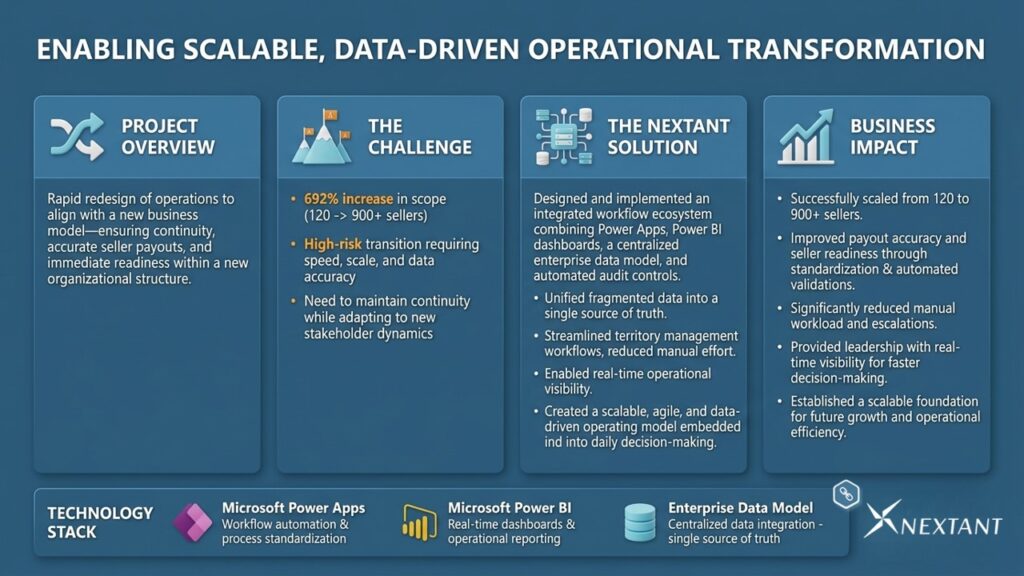
The primary challenge stemmed from a sudden 692% increase in scope driven by a large-scale client reorganization. This required a rapid redesign of operational support to expand coverage from 120 to more than 900 sellers while driving operational continuity across all processes.
The transformation had to be executed while minimizing disruption, maintaining data accuracy, and ensuring seamless continuity for both customers and stakeholders. Balancing speed, scale, and precision in a high-risk transition environment was critical.
Solution: Building a Scalable Workflow Automation Ecosystem with Power Apps and Power BI
To address this challenge, Nextant designed and implemented a fully integrated workflow ecosystem combining a Power App, Power BI dashboards, automated audit reporting, and a scalable enterprise data model, all focused on driving operational continuity across the organization.
The solution was intentionally built around business priorities, stakeholder feedback, and the most common escalation scenarios. This approach enabled a more agile, scalable, and data-driven operating model.
1) Enterprise Data Model Creation
At the foundation of the solution was the creation of an accurate and consolidated enterprise data model that unified multiple databases and connected critical business dimensions into a single source of truth, enabling driving operational continuity across key processes. This integrated framework consolidated seller HR records, account segmentation data, partner information, territory setup inputs, and other key operational datasets.
By centralizing these data sources, the business gained the ability to analyze operations from multiple perspectives while supporting critical monthly needs such as seller setup changes, territory updates, and new hire onboarding during peak seasonal periods. Automated refresh and maintenance processes ensured the data remained continuously up to date and reliable.
2) Power App + Workflow Automation
Nextant developed a Power App–driven workflow that streamlined the end-to-end Territory Management process, supporting driving operational continuity across critical operations. The application standardized intake, simplified stakeholder collaboration, and reduced manual effort associated with high-volume updates and escalations.
This automation significantly improved turnaround times, reduced risk of human error, and created a scalable framework capable of supporting the client’s rapidly expanding business structure.
3) Power BI Reports Development
To enable real-time decision-making, the team developed a comprehensive suite of Power BI dashboards tailored to the organization’s specific business and leadership needs, contributing to driving operational continuity across critical functions. These dashboards were designed to provide a clear, real-time view of operational health, seller setup status, and key opportunities requiring action.
4) Automated Audits + Governance
To strengthen operational accuracy and governance, the integrated workflow introduced automated audit reports that proactively flagged incorrect setups, missing data, and records requiring updates, reinforcing driving operational continuity across the organization.
These controls reduced manual validation efforts while improving data quality, compliance, and stakeholder confidence in the workflow’s integrity.
5) Embedded into the Rhythm of Business
To maximize adoption and business impact, Nextant aligned reporting outputs with the client’s business rhythm, customizing dashboards and views to support recurring leadership meetings, review cadences, and cross-functional operating forums, all contributing to driving operational continuity across the organization.
This enabled data-driven conversations, improved meeting effectiveness, and ensured a shared, real-time view of business status both inside and outside formal review sessions.
6) Training, Support, and Continuous Improvement
To ensure long-term sustainability, Nextant provided training and ongoing support to business teams, enabling stakeholders to confidently use the tools and dashboards in their day-to-day decision-making while driving operational continuity across the organization.
A continuous feedback loop was also established to gather stakeholder input and prioritize iterative enhancements, ensuring the solution evolved in line with changing business needs and strategic goals.
Business Impact: Scaling Operations with Workflow Automation and Data Integration
The integrated workflow ecosystem enabled the client to successfully navigate a period of rapid transformation while maintaining operational continuity and service quality at scale.
1) Successfully absorbed a 692% scope increase
The redesigned operating model enabled the team to scale support from 120 to 900+ sellers with minimal disruption, successfully absorbing a 692% increase in scope driven by the client’s reorganization.
Despite the rapid expansion, the solution maintained continuity across critical monthly processes, including seller setup updates, territory changes, and new hire onboarding, ensuring the business remained operationally stable during a high-risk transition period while driving operational continuity across all functions.
2) Improved payout accuracy and seller readiness
By consolidating fragmented data sources into a single source of truth and embedding automated validation controls, the solution significantly improved the accuracy and timeliness of seller setups while driving operational continuity across key business processes.
This directly supported the client’s primary business objective: ensuring sellers received accurate, on-time payouts and were aligned to the correct business structure to drive performance from day one.
3) Reduced manual effort and escalations
The Power App workflow, automated audits, and standardized reporting substantially reduced the manual workload associated with high-volume requests, exception handling, and escalation management, supporting driving operational continuity across operational processes.
This improved turnaround times, minimized human error, and allowed the team to redirect effort from transactional support toward higher-value strategic stakeholder engagement and business advisory activities.
4) Real-time visibility for leadership decision-making
The Power BI dashboard suite provided leadership and business stakeholders with real-time operational visibility, enabling faster identification of risks, setup gaps, and pending actions.
By embedding these dashboards into the client’s rhythm of business, the organization established a shared, data-driven view of business health, improving meeting effectiveness and accelerating decision-making across cross-functional teams while driving operational continuity across the organization.
5) Established a scalable transformation foundation
Beyond solving the immediate business challenge, the solution created a repeatable and scalable framework for future organizational changes, seasonal onboarding spikes, and evolving business priorities, supporting driving operational continuity over time.
The combination of workflow automation, centralized data governance, and continuous improvement processes positioned the client for sustained operational resilience and future growth.
Struggling to manage increasing operational complexity? Talk to our transformation specialists.
Conclusion: From Operational Complexity to Scalable, Data-Driven Execution
This initiative transformed a high-risk operational challenge into a scalable, data-driven operating model. By preserving seller confidence, protecting payout accuracy, and enabling seamless scalability, the client sustained business momentum during a period of rapid transformation while driving operational continuity and building a strong foundation for future success.
Frequently Asked Questions (FAQ)
1. What is workflow automation, and how does it improve business operations?
Workflow automation uses technology to streamline and standardize business processes, reducing manual tasks and errors while driving operational continuity across the organization. It improves operational efficiency, accelerates turnaround times, and enables organizations to scale without increasing complexity. For a deeper understanding of how automation tools support these capabilities, explore Microsoft’s overview of workflow automation.
2. How does an enterprise data model support operational scalability?
An enterprise data model consolidates multiple data sources into a single source of truth. This enables more accurate data, real-time insights, and consistent decision-making—key factors for scaling operations effectively.
3. What are the benefits of using Power BI for operational reporting?
Power BI provides real-time dashboards and analytics that give leadership full visibility into business performance. It helps identify risks, track KPIs, and make faster, data-driven decisions across teams.
4. How can businesses manage rapid growth without disrupting operations?
Organizations can manage rapid growth by implementing scalable workflows, automating key processes, and centralizing data. This ensures continuity, reduces errors, and supports expansion without operational bottlenecks.
5. Why is data governance important in workflow automation?
Data governance ensures that information is accurate, consistent, and compliant across systems. When combined with automated audits and validation processes, it strengthens data quality and builds trust in operational reporting.